
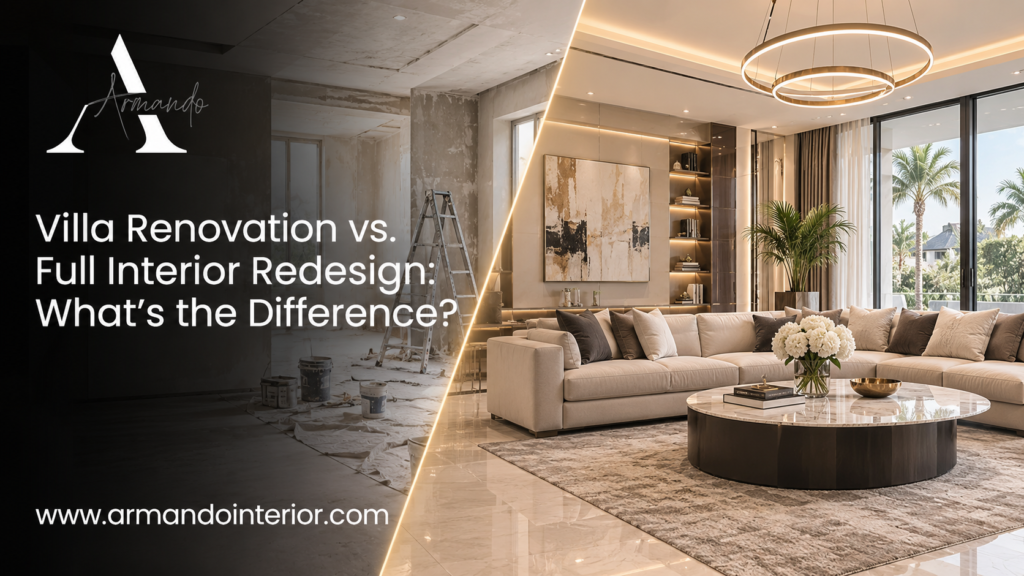
If you’re a villa owner in Dubai starting to think about updating your home, you’ve probably come across both terms—”renovation” and “interior redesign“—often used interchangeably by contractors and homeowners alike. But they actually describe two quite different scopes of work, with very different budgets, timelines, and outcomes. Understanding the distinction before you start requesting quotes will save you significant confusion and help you have a much more accurate conversation with any design or fit-out company you speak to.
This guide clarifies exactly what separates a villa renovation from a full interior redesign and helps you figure out which one your villa actually needs.
The Core Difference, Simply Explained
- Villa renovation refers to physical, structural, or systems-level work—repairing, replacing, or upgrading the building’s actual components: flooring, plumbing, electrical systems, wall structures, roofing, or outdated fixtures. It’s fundamentally about restoring or upgrading the villa’s condition and functionality.
- “Interior redesign” refers to reimagining the look, feel, and layout of the existing space — new furniture, updated color schemes, revised layouts, styling, and finishes—without necessarily changing the underlying structure or systems.
In short: renovation fixes and upgrades what’s there; redesign reimagines how it looks and functions aesthetically. Many projects genuinely need both, but knowing which one you’re prioritizing changes everything about scope, budget, and the type of company you should hire.
What Counts as Villa Renovation
Renovation work typically addresses the villa’s underlying condition and infrastructure. Common renovation scopes in Dubai villas include:
- Plumbing system upgrades — replacing aging pipes, fixing water pressure issues, upgrading to modern fixtures
- Electrical rewiring — especially common in older villas (10+ years) where wiring may no longer meet current safety standards or support modern electrical loads
- Flooring replacement due to damage, wear, or outdated material (not just a style update)
- Structural repairs — cracks, water damage, roofing issues, or foundation-related concerns
- HVAC system upgrades — replacing or upgrading air conditioning systems that are inefficient or failing
- Waterproofing, particularly relevant for villas with pools, gardens, or roof terraces where water damage is a recurring risk
- Window and door replacement for energy efficiency, security, or structural integrity
Renovation is typically driven by necessity — something is worn out, damaged, outdated in a functional sense, or no longer meets safety standards — rather than purely by aesthetic preference.
What Counts as Interior Redesign
Redesign work focuses on the visual and experiential quality of the space, generally without addressing structural or systems-level issues. Common redesign scopes include:
- Furniture and furnishings — new sofas, dining sets, bedroom furniture, curtains, rugs
- Color and material updates — repainting, new wallpaper, updated cabinet fronts or countertops
- Layout reconfiguration — adjusting how rooms are used or furnished, sometimes involving non-structural partition changes
- Lighting design updates — new fixtures, improved lighting layers, updated switches and controls
- Styling and décor — artwork, accessories, plants, and the finishing details that give a space personality
- Kitchen and bathroom cosmetic updates — new cabinet fronts, countertops, or fixtures without changing the underlying plumbing layout
Redesign is typically driven by a desire to modernize the look, improve functionality within the existing structure, or simply refresh a space that has fallen out of step with the owner’s taste or lifestyle.
Why the Distinction Matters for Your Budget
Renovation and redesign draw from very different cost categories, and confusing them leads to significantly inaccurate budgeting:
- Renovation costs are driven by labor-intensive structural and MEP (mechanical, electrical, plumbing) work, which often requires permits, approvals, and specialized tradespeople. Even “invisible” renovation work — like rewiring behind walls — can represent a large portion of a project’s budget without any visible aesthetic change.
- Redesign costs are driven primarily by furniture, finishes, and styling — generally more visible, more flexible, and easier to phase or adjust based on budget.
A villa owner budgeting purely for “new furniture and paint” (redesign-level thinking) can be caught off guard if a professional assessment reveals the electrical system genuinely needs upgrading first (a renovation-level need) — which is a common and costly surprise in older Dubai villas.
Signs Your Villa Needs Renovation First
- Frequent plumbing issues — low water pressure, recurring leaks, or drainage problems
- Visible cracks in walls or ceilings, particularly near windows or structural joints
- An aging or inefficient air conditioning system that struggles to cool the villa properly
- Electrical issues — flickering lights, tripped breakers, or an outdated fuse box
- Water damage or persistent damp patches, especially in villas with older waterproofing
- A villa older than 10–15 years that hasn’t had any major systems upgrade
If any of these apply, addressing renovation needs before or alongside any aesthetic redesign work is the financially responsible order of operations — redesigning a beautiful space on top of failing infrastructure is a false economy.
Signs Your Villa Just Needs a Redesign
- The villa’s structure, plumbing, and electrical systems are in good working condition
- Your main frustration is that the space feels dated, doesn’t reflect your taste, or no longer suits your lifestyle (new family, remote work needs, entertaining more often)
- Furniture and finishes are worn or simply not to your taste, but not structurally compromised
- You’re preparing the villa for sale or rental and want to maximize appeal without major structural investment
When You Need Both — The Most Common Scenario
In practice, many Dubai villa projects — especially villas over 8–10 years old — involve a combination of renovation and redesign, and this is where working with an experienced design-and-build team becomes particularly valuable. A typical combined project might involve:
- Assessment phase — identifying which systems (plumbing, electrical, HVAC) genuinely need renovation-level work
- Renovation phase — addressing structural and systems issues first, since this work often needs to happen before finishes are installed
- Redesign phase — layering in the new flooring, paint, lighting, furniture, and styling once the underlying systems are sound
Sequencing matters significantly here — installing beautiful new flooring before confirming the plumbing beneath it doesn’t need work is a common and expensive mistake.
How to Get an Accurate Assessment
Since renovation needs aren’t always visible on the surface, it’s worth requesting a proper site assessment before committing to a purely aesthetic redesign budget:
- Ask for a structural and systems walk-through as part of your initial consultation, even if your main interest is redesign
- Request that any electrical or plumbing concerns be flagged explicitly in the proposal, rather than assumed to be fine
- Get a combined quote broken into renovation and redesign line items, so you understand exactly where your budget is going and can prioritize if funds are limited
Choosing the Right Team for Each Scope
- Pure redesign projects can often be handled efficiently by an interior design and styling-focused team, without needing extensive construction capability
- Renovation-heavy projects need a team with genuine construction, MEP, and structural expertise — not just design sensibility
- Combined projects are best handled by a single design-and-build company managing both scopes, since this avoids the coordination gaps and finger-pointing that can happen when separate renovation contractors and interior designers aren’t working from the same plan
Frequently Asked Questions About Villa Renovation vs. Interior Redesign
How do I know if my villa’s electrical system needs a full renovation?
Warning signs include frequently tripped breakers, flickering lights, outlets that feel warm to the touch, or a fuse box that looks visibly outdated compared to modern standards. If your villa is more than 10–15 years old and has never had an electrical assessment, it’s worth requesting one before committing to a purely cosmetic redesign budget.
Can interior redesign work be done while renovation work is still in progress?
It’s generally more efficient and cost-effective to complete renovation-level work — plumbing, electrical, structural repairs — before finalizing redesign elements like flooring and paint, since redesign work installed before renovation is complete often needs to be redone or risks damage. A phased approach that sequences renovation first, then redesign, tends to produce better results and avoid rework costs.
Does villa renovation increase property value more than redesign?
Both can add value, but they add it differently — renovation addresses fundamental condition and functionality, which matters significantly to buyers and appraisers, while redesign primarily affects visual appeal and marketability. For villas with genuine structural or systems issues, addressing renovation needs typically has a greater impact on resale value than redesign alone.
How much does villa renovation typically cost compared to redesign?
Renovation costs vary enormously depending on the scope of structural and MEP work needed, but as a general guide, addressing electrical, plumbing, and HVAC issues in a mid-sized villa can range from AED 150,000–400,000, separate from any redesign or furnishing budget. Getting a professional assessment is the only reliable way to estimate renovation costs accurately, since issues aren’t always visible on the surface.
Is it worth getting a professional inspection before starting a redesign project?
Yes — even if your primary interest is aesthetic redesign, a professional walk-through that flags any structural or systems concerns can prevent a costly situation where beautiful new finishes need to be removed shortly after installation to address an underlying issue. Most reputable design-and-build companies in Dubai include this assessment as part of an initial consultation.
Can I renovate my villa in stages if I can’t afford both renovation and redesign at once?
Yes, and this is a common and sensible approach, particularly for villas needing significant systems work. Prioritizing safety and functionality-critical renovation first (electrical, plumbing, structural issues) and phasing redesign work as budget allows is generally more financially sound than attempting both simultaneously on a constrained budget.
Final Thoughts
Villa renovation and interior redesign solve genuinely different problems — one restores and upgrades what’s physically there, the other reimagines how a space looks and feels. Confusing the two is one of the most common sources of budget shock in Dubai villa projects, particularly for older properties where hidden systems issues aren’t obvious until a professional assessment uncovers them.
Before committing to a purely cosmetic budget, it’s worth getting a combined assessment that honestly addresses both dimensions of your villa’s needs. Armando Interior offers consultations that evaluate both the structural and aesthetic condition of your villa, helping you understand exactly what renovation and redesign work is genuinely needed — and in what order — before your budget is finalized.