
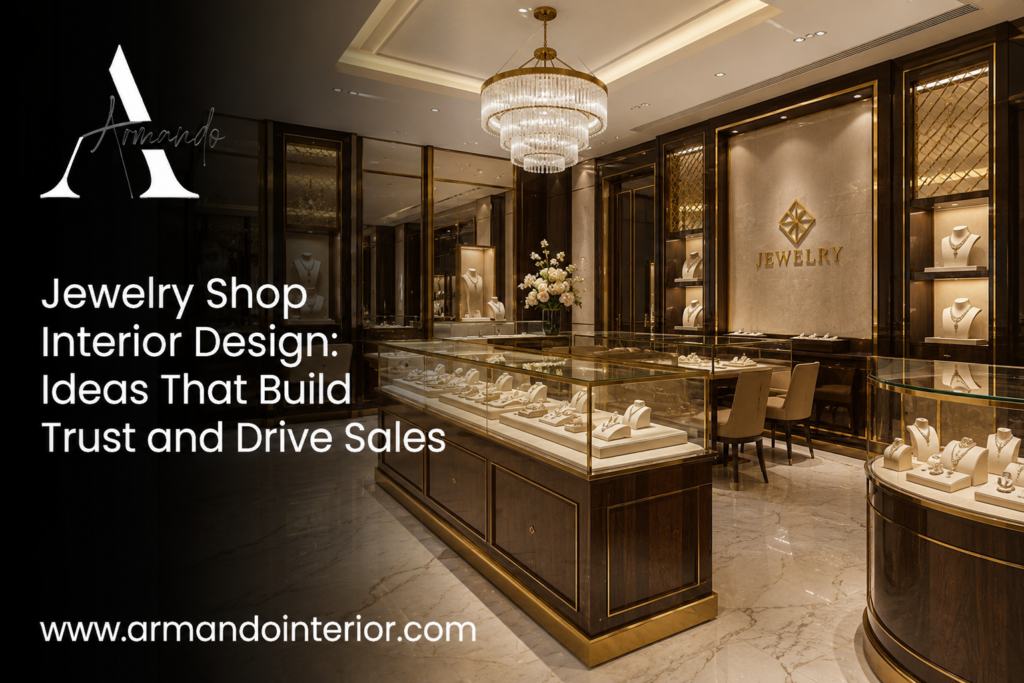
Walk into a jewelry store and, before you ever look at a single ring or necklace, your brain has already made a judgment. Is this a place I trust with my money? Does this brand understand luxury? Will the person helping me actually know what they’re talking about? All of that happens in the first three to five seconds, and almost none of it comes from the products on display. It comes from the room itself the lighting, the materials, the layout, the way sound moves through the space. For a category built entirely on trust, emotion, and perceived value, interior design isn’t decoration. It’s the sales strategy.
Jewelry is one of the only retail categories where the product is small, the price is high, and the decision is emotional. A customer buying a $50 shirt doesn’t need much convincing. A customer considering a $15,000 engagement ring needs to feel safe, respected, and genuinely wowed. That’s a much heavier lift, and it’s one that falls almost entirely on the shoulders of the physical space. This guide walks through the design principles that separate jewelry stores that feel like showrooms from those that feel like glorified pawn shops, and shows how thoughtful interior design directly translates into higher average transaction values and stronger customer loyalty.
Why Interior Design Matters More in Jewelry Than Almost Any Other Retail Category
In most retail environments, design supports the sale. In jewelry retail, design often is the sale. Because the merchandise itself is small and frequently locked behind glass, customers can’t touch, try on freely, or examine products the way they would in a clothing or homeware store. The environment has to do the work of communicating value that the product can’t fully do on its own in that first glance. A poorly lit store with dated fixtures and mismatched flooring signals, consciously or not, that the jewelry inside might be poorly made or overpriced — regardless of whether that’s true. Conversely, a space with intentional lighting, quality materials, and a considered layout tells the customer, before a single word is spoken, that they are somewhere serious, safe, and worth their time.
There’s also a security dimension unique to this category. Customers are aware, at some level, that jewelry stores are targets for theft, and a space that feels chaotic or poorly monitored can create subconscious unease. Good design reassures without ever feeling like a vault. It’s a careful balance, and it’s one of the reasons jewelry store interiors require a more specialized approach than most retail fit-outs.
Lighting: The Silent Salesperson
If there’s one element that matters more than any other in a jewelry store, it’s lighting. Diamonds and gemstones are designed by nature to interact with light — that’s literally what creates sparkle, fire, and brilliance. Flat, generic overhead lighting flattens all of that. A well-lit jewelry store uses layered lighting: ambient light to set the overall mood, accent lighting focused precisely on display cases to make stones and metals come alive, and task lighting at consultation desks so staff and customers can genuinely examine pieces up close.
Color temperature matters enormously here. Warm light (around 2700K–3000K) tends to flatter gold, warm-toned diamonds, and skin tones, creating an inviting, boutique feel. Cooler light (4000K and above) makes white diamonds and platinum pop with more clarity but can feel clinical if overused. Most successful jewelry interiors blend the two — warm ambient lighting throughout the space with cooler, high-CRI (color rendering index) spotlights directly over cases. A CRI of 90 or above is generally the minimum worth considering; anything lower and stones simply won’t show their true color.
Fiber optic and LED display lighting has also become the industry standard for case interiors because it produces minimal heat, which protects both the merchandise and the customer’s fingers when handling pieces. Dimmable systems allow a shop to shift the mood from bright and energetic during the day to warm and intimate for evening appointments or private viewings.
Display Cases and Layout That Guide the Customer’s Journey
The layout of a jewelry store should function like a well-told story, not a maze. Most successful stores use a loose horseshoe or racetrack layout, drawing customers along the perimeter past feature cases before opening into a central area with either freestanding vitrines or a consultation zone. This keeps sightlines open — customers should always be able to see a staff member and never feel boxed in or watched, both of which create discomfort.
Case height and angle matter more than most people realize. Cases that are too tall create a barrier between staff and customer, making the interaction feel transactional and cold. The ideal case height typically sits between 38 and 42 inches, angled slightly so pieces are visible from a natural standing position without customers having to crane their necks or lean uncomfortably. Grouping merchandise thoughtfully — engagement rings in one zone, watches in another, statement pieces near the entrance as an aspirational anchor — helps customers self-navigate before staff even approach.
- Keep sightlines open from the entrance to the back of the store for a feeling of safety and transparency.
- Use feature cases or a single striking piece near the entrance to set the tone immediately.
- Angle cases 10–15 degrees for better visibility without forcing an uncomfortable posture.
- Leave generous walking space (at least 42–48 inches) between cases so the store never feels cramped.
Color Palette and Materials: Speaking the Language of Luxury
Materials and color choices carry an enormous amount of unspoken meaning in a jewelry store. Deep, saturated tones — navy, emerald, burgundy, charcoal — paired with warm metals like brushed brass or antique gold create an atmosphere of heritage and craftsmanship. Lighter palettes with soft neutrals, marble, and champagne accents lean more contemporary and are often favored by bridal-focused or younger, fashion-forward brands. Neither approach is inherently better; the right choice depends entirely on the brand identity a store is trying to project.
What matters more than the specific palette is material quality. Customers who are about to spend a significant sum on jewelry are, whether they realize it or not, evaluating everything around them as a proxy for quality — including the countertops, the flooring, the upholstery on the seating. Laminate that mimics stone, or fixtures with visible wear, undercut the very message the store is trying to send. Natural stone, solid wood, brushed or polished metals, and high-quality upholstery fabrics are worth the investment because they reinforce the exact promise the merchandise itself is making.
Mirrors and Visual Merchandising
Mirrors deserve special attention in jewelry retail because they do double duty: they’re functional (customers need to see how a piece looks on them) and they’re spatial tools (they can make a small boutique feel significantly larger and brighter). Full-length mirrors near seating areas, along with smaller handheld and countertop mirrors at every case, remove friction from the try-on experience. Positioning matters — a mirror placed so a customer can see a necklace or earrings in good, flattering light is far more likely to result in a sale than one tucked in a dim corner.
Beyond mirrors, visual merchandising principles like the rule of odd numbers (grouping pieces in threes rather than pairs), varying height within a single case to create visual rhythm, and rotating featured pieces regularly all keep displays feeling fresh and intentional rather than static.
Creating Distinct Zones: Browsing, Consultation, and VIP
The most successful jewelry stores don’t treat the entire footprint as one undifferentiated retail floor. They create zones with different emotional registers. A browsing zone near the entrance should feel open and low-pressure, allowing customers to explore without immediately being approached. A consultation zone — typically a seated area with a desk or table, softer lighting, and a bit more privacy — is where the real sales conversations happen, particularly for high-ticket items like engagement rings or custom pieces.
For stores that can support it, a private VIP or consultation room takes this further, offering a fully enclosed space for customers making major purchases or those who simply prefer discretion. These rooms are increasingly common in bridal jewelry, where the emotional stakes and price points are both high, and privacy can meaningfully reduce the anxiety that often surrounds engagement ring shopping.
Flooring and Acoustics
Flooring in a jewelry store needs to balance elegance with practicality. Hard surfaces like marble, terrazzo, or engineered stone photograph beautifully and reinforce a premium feel, but they can also create harsh acoustics and a cold, echoey atmosphere if not managed carefully. Area rugs in consultation zones soften both the visual and the acoustic experience, while also delineating space without the need for physical walls.
Acoustics are an underrated part of jewelry store design. A space that’s too echoey makes private conversations about price and financing feel exposed, which is uncomfortable for customers discussing five- and six-figure purchases. Soft furnishings, acoustic ceiling treatments, and even the placement of greenery can meaningfully reduce noise reflection and make consultation areas feel more private, even in an open layout.
Integrating Security Without Sacrificing Warmth
Security is non-negotiable in jewelry retail, but it doesn’t have to look institutional. Modern jewelry store design integrates security almost invisibly: laminated or polycarbonate glass that looks identical to standard display glass but resists forced entry, discreetly placed cameras built into ceiling design elements rather than bulky visible domes, and case-locking systems that operate smoothly enough not to slow down the sales interaction. Even elements like reinforced back walls behind cases or bollards disguised as planters near entrances contribute to safety without ever announcing themselves.
The goal is a space where customers feel secure because the overall environment feels considered and cared for — not because they’re staring at visible bars, bulky cameras, or an obviously locked-down feel that suggests distrust between the store and the people walking through the door.
Branding Consistency: Every Surface Tells the Story
A jewelry store’s interior should feel like a physical extension of its brand identity, down to details many customers won’t consciously notice but will absolutely feel. Signage typography, the finish on door handles, the packaging visible at the register, even the scent in the air — all of it either reinforces or undermines the brand promise. Inconsistency is where trust erodes fastest. A store with an elegant, minimalist logo but a cluttered, mismatched interior sends a confusing signal that customers register as a lack of attention to detail, which is a dangerous thing to signal when you’re asking someone to trust you with a significant purchase.
Boutique vs. Showroom: Scaling the Approach
A 400-square-foot boutique and a 4,000-square-foot flagship showroom require fundamentally different design strategies, even if the underlying principles stay the same. In smaller boutiques, every square foot needs to work harder — mirrors, light color, and a tightly curated case layout become essential tools for making the space feel intentional rather than cramped. Larger showrooms have room to build out distinct zones, feature walls, and multiple consultation areas, but they also risk feeling impersonal or cavernous if the design doesn’t intentionally break the space into warmer, human-scaled sections.
Regardless of size, the same underlying question should guide every decision: does this choice make the customer feel more confident about spending money here? If a design element doesn’t clearly answer yes, it’s worth reconsidering.
Common Mistakes That Undermine Trust
- Overly bright, flat lighting that flattens sparkle instead of enhancing it.
- Cases positioned too close together, creating a cramped, budget feel.
- Inconsistent finishes — mixing too many metal tones or material types without a clear plan.
- Visible security elements that feel aggressive rather than reassuring.
- No dedicated seating or consultation area for high-value conversations.
- Cluttered visual merchandising that overwhelms rather than highlights key pieces.
How Armando Interior Approaches Jewelry Store Design
At Armando Interior, we treat every jewelry retail project as an exercise in psychology as much as aesthetics. Our process starts with understanding the brand’s positioning — heritage or contemporary, bridal-focused or fashion-forward — and builds the lighting plan, material palette, and layout around that identity from the very first sketch. We work closely with jewelers to integrate security seamlessly, design consultation zones that put customers at ease, and select materials that hold up beautifully under the kind of scrutiny high-value retail demands.
From flagship showrooms to intimate boutique fit-outs, our team designs spaces where every detail — the angle of a display case, the temperature of a spotlight, the texture of a countertop — works together to build the kind of trust that turns browsers into buyers.
Final Thoughts
Jewelry store interior design isn’t about following trends; it’s about engineering an environment where trust, desire, and confidence can build naturally in the few minutes a customer spends inside. Lighting that makes stones come alive, layouts that guide without controlling, materials that quietly reinforce quality, and security that reassures without intimidating — together, these elements do far more selling than any single piece of merchandise ever could on its own.
If you’re planning a new jewelry store, renovating an existing space, or simply want to see how thoughtful design can lift your sales, visit Armando Interior to explore our portfolio and start a conversation about your project.